Everything But [in] The Kitchen Sink
Contributor
World Building
What if the kitchen sink—ordinary, recessed, obedient—was quietly repurposed as a site of planetary calibration?
In this version of the domestic world, the sink does not simply collect what remains after use; it hosts a small but restless cosmology of found objects. The basin becomes a sinkscape: a staged micro-world where chrome faucet “stems” sprout perforated leaves, surveillance lenses nest beside patterned teacups, and inflated mesh creatures lounge in the sudsy shallows plotting their between-wash shenanigans. These unlikely inhabitants gather around the canonical fixture, turning the sink into a choreography of care, clutter, maintenance, and quiet domestic mischief.
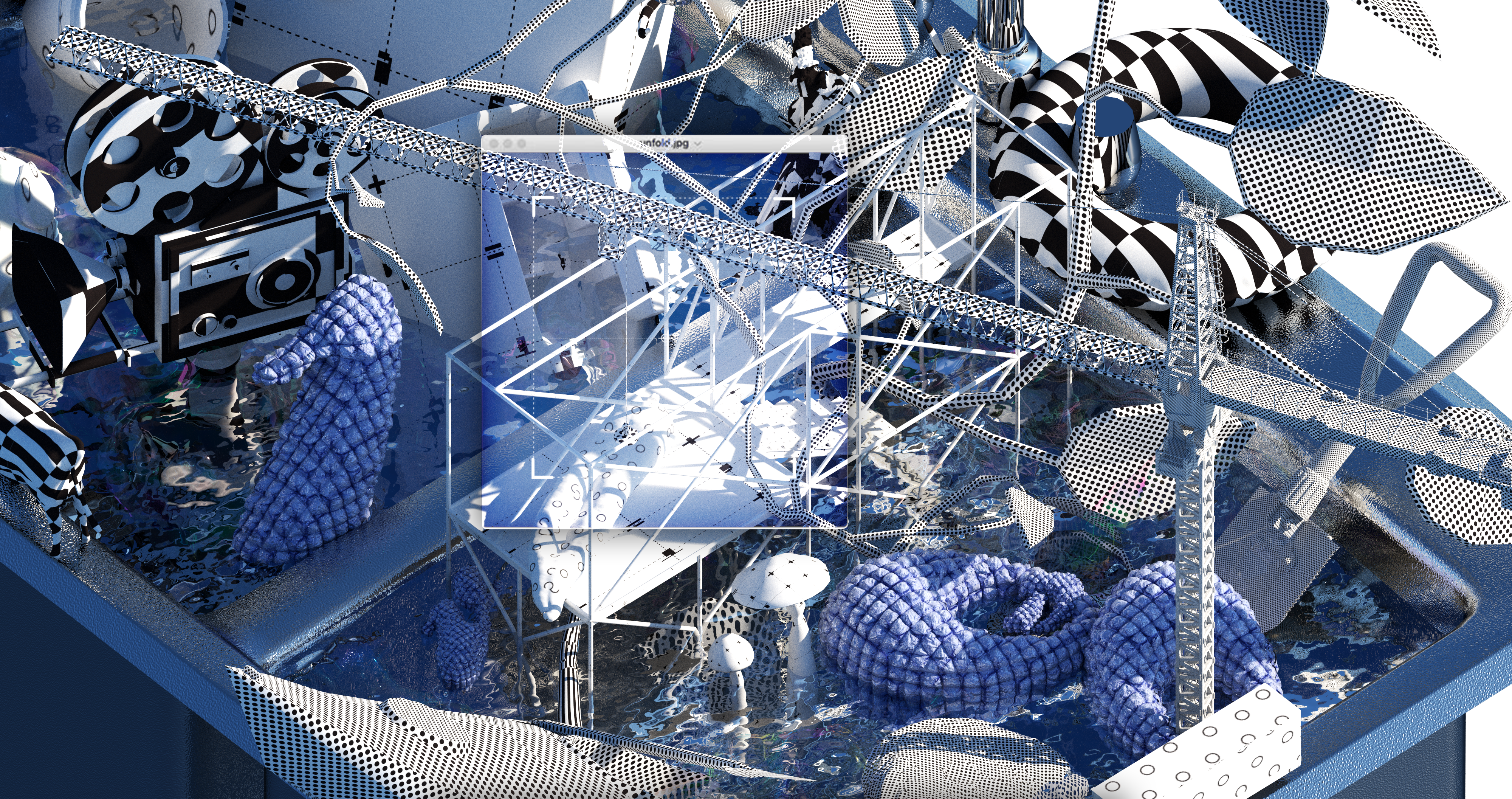
Set within a hyper-textured, gridded kitchen landscape, the world resists tidy resolution. Instead, it performs a playful inversion of the phrase “everything but the kitchen sink.” Here, everything is in the kitchen sink, even you. The basin becomes part garden, part archive, part soap slick, part glitch field—each identity interfering with the last, flickering in and out of hatched resolution. One must take caution wading through the thickets of garburator e-waste, dodging striped ceramic vessels as they bob beside camera modules, foam-speckled platforms on their own drift, and robotic vegetable fragments sopping through the dishwater. As such, the drain behaves less like an endpoint than a portal, pooling rinsed pigments, stray fibers, fragments of patterned packaging, and drifting packets of “homegrown” metadata. Microbial logics mingle with machinic sensing, forming a feedback loop between what is being cared for and what is silently being contaminated.
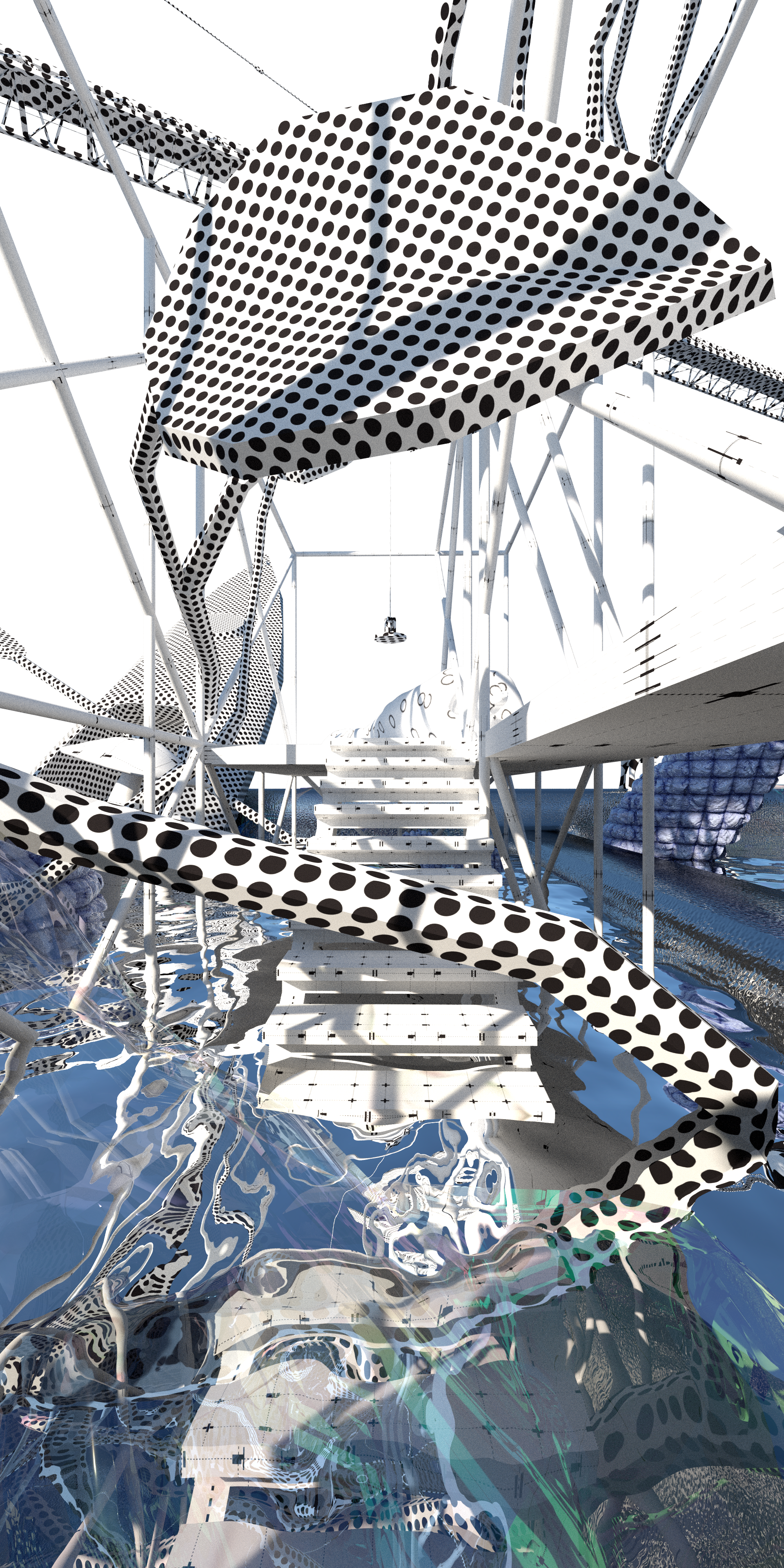
Over time the sink thickens into a soft archive of domestic surplus. Scaffolds colonize the basin, mesh organisms curl along the rim, and blue inflatable forms nap beside checkerboard cups and wandering gadgets. The sink becomes an improbable compost heap where matter and information—soap bubbles, crumbs, sensors, scraps—slowly reorganize themselves. Designed less for human users than for the organic and machinic inhabitants of distant kitchen worlds, this sinkscape proposes a tiny but exuberant infrastructure of excess and upkeep.
And so the sink, long treated as a site of disappearance and ritual cleansing, re-emerges as a bustling planetary laboratory: a place where umbrellas shade drifting robots, plants grow from plumbing, and the smallest act of rinsing quietly reorganizes the architecture of the world.