An Extraordinary World on Ordinary Ground
Contributor
World Building
On May 5, 1926, on unpaved ground in North Philadelphia, between North 11th Street and West Erie Avenue, the Ringling Bros. and Barnum & Bailey Combined Shows built a new world on bare ground, inside the city but separated from its urban fabric.
From the air, two different spatial arrangements coexisted on the same land—one orderly, the other irregular. The tents transformed this transitional space, hemmed in by the neighborhood and infrastructure. On the north and west, it was bordered by trolley and railroad tracks and a lumber yard; on the east, by the backs of rowhomes; and on the south, by an open, undeveloped path leading to the street, disrupting the urban grid.
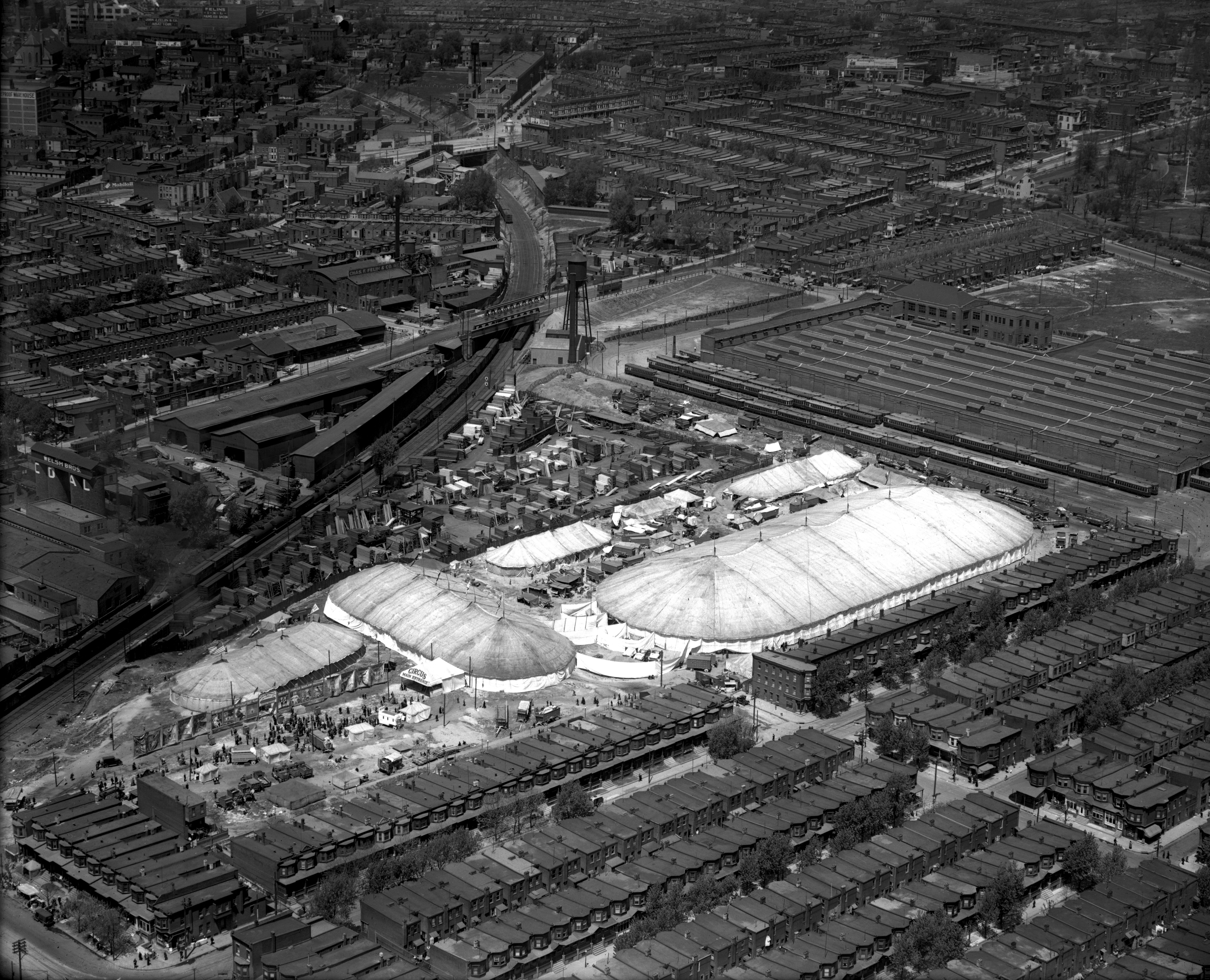
The Ringling show, like all traveling circuses, used tents to create a mobile, repeatable spatial operation. The circus moved every day, setting up and taking down its whole operation between sunrise and sunset. Trains arrived early in the morning to set up, perform, pack up, and head to the next city. Upon nightfall, the tents fell, the circus packed its rail cars, and steamed away to its next host.
By the 1920s, the circus lot design could adapt to fit any site it could occupy. The layout of the circus lot was developed over decades through repetition, competition, and refinement. The circus did not conform to the city; it imposed its order on whatever ground the advance agents could secure. Contracts were signed, and the circus filled the space with its own world.
Inside the lot was a socially rich yet stubbornly hierarchical community of managers, performers, roustabouts, canvasmen, candy butchers, and agents. Rank determined where you slept, when you ate, and how close you lived to the show tents. They lived, moved, and performed as a family that chose to be
nomadic. Their outsider status, exposed wherever they traveled, was what bound them together and made their world possible.
The showfolk divided the lot into social zones and performative thresholds. Public-facing tents followed a structuring axis, while private tents haphazardly filled the leftover ground behind it. The Midway served as the circus’s Main Street, with the sideshow running alongside it, the public entrance at one end, and the animal Menagerie and Big Top at the other. The back-of-house held the tents where performers and staff ate, prepared for shows, and rested when they could.
Upon crossing the threshold between the urban fabric and the circus lot, visitors first encountered the Midway, where they could see sideshow “freaks,” buy tickets and concessions, and experience an inexplicable otherworldliness. Walking down the Midway, painted Sideshow banners highlighted the unusual and mysterious bodies that, for a small price, visitors could bear witness to. The Sideshow talker loudly proselytized about the oddities the public might find themselves sharing space with, if only they mustered the strength and handed over 15 cents. The air on the Midway was full of sweet and earthy scents from the kettle corn, lemonade, confectionery, and a menagerie of horses, zebras, and elephants. The sodden ground covered in hay, which gave a temporary stability underfoot, emitted a scent reminiscent of farm life. Tents exuded brass march music in a muffled blare across the Midway.
In Of Other Spaces, Michel Foucault described heterotopia as an “effectively enacted utopia,” a real counter-site, a physical “world.” The traveling circus was an “absolutely temporal” heterotopia, characterized by its impermanence and its ability to construct a whole world in an instant. It could only exist in relation to the city it displaced, occupying its ground while refusing its logic. The traveling circus existed in one place for less than 24 hours, leaving only trampled dirt behind. On its departure, the circus left people bereft. The thing that had brought them so much wonder and excitement had run away, turning what had been, for a brief moment, an extraordinary world back into ordinary ground. Their only reprieve would come on Circus Day the following year.
The circus tents were pristine. However, the canvas touched the ground countless times throughout the season. The soil from previous lots became embedded in the canvas as it was unfurled, raised, and lowered. By the end of the season, the canvas carried dirt from over a hundred cities. In inclement weather, wind and rain splashed muddy water up the sidewalls. This contradiction between aspiration and material reality reveals the heterotopia: the pristine image represents its aspiration and utopian vision, but the material record tells a different story. It shows that this world was real, not merely imagined. The circus wielded its well-worn canvas, hauled from city to city to disrupt the urban landscape, only to vanish before the ground could dry out.
Foucault, Michel. “Of Other Spaces: Utopias and Heterotopias.” Translated by Jay Miskowiec. Diacritics 16, no. 1 (1986): 24–26. https://doi.org/10.2307/464648.